Chapter One

The studio was filled with the rich odour of roses, and when the light summer wind stirred amidst the trees of the garden, there came through the open door the heavy scent of the lilac, or the more delicate perfume of the pink-flowering thorn.

From the corner of the divan of Persian saddle-bags on which he was lying, smoking, as was his custom, innumerable cigarettes, Lord Henry Wotton could just catch the gleam of the honey-sweet and honey-coloured blossoms of a laburnum, whose tremulous branches seemed hardly able to bear the burden of a beauty so flamelike as theirs; and now and then the fantastic shadows of birds in flight flitted across the long tussore-silk curtains that were stretched in front of the huge window, producing a kind of momentary Japanese effect, and making him think of those pallid, jade-faced painters of Tokyo who, through the medium of an art that is necessarily immobile, seek to convey the sense of swiftness and motion. The sullen murmur of the bees shouldering their way through the long unmown grass, or circling with monotonous insistence round the dusty gilt horns of the straggling woodbine, seemed to make the stillness more oppressive. The dim roar of London was like the bourdon note of a distant organ.

In the centre of the room, clamped to an upright easel, stood the full-length portrait of a young man of extraordinary personal beauty, and in front of it, some little distance away, was sitting the artist himself, Basil Hallward, whose sudden disappearance some years ago caused, at the time, such public excitement and gave rise to so many strange conjectures.

As the painter looked at the gracious and comely form he had so skilfully mirrored in his art, a smile of pleasure passed across his face, and seemed about to linger there. But he suddenly started up, and closing his eyes, placed his fingers upon the lids, as though he sought to imprison within his brain some curious dream from which he feared he might awake.

“It is your best work, Basil, the best thing you have ever done,” said Lord Henry languidly. “You must certainly send it next year to the Grosvenor. The Academy is too large and too vulgar. Whenever I have gone there, there have been either so many people that I have not been able to see the pictures, which was dreadful, or so many pictures that I have not been able to see the people, which was worse. The Grosvenor is really the only place.”

“I don’t think I shall send it anywhere,” he answered, tossing his head back in that odd way that used to make his friends laugh at him at Oxford. “No, I won’t send it anywhere.”

Lord Henry elevated his eyebrows and looked at him in amazement through the thin blue wreaths of smoke that curled up in such fanciful whorls from his heavy, opium-tainted cigarette. “Not send it anywhere? My dear fellow, why? Have you any reason? What odd chaps you painters are! You do anything in the world to gain a reputation. As soon as you have one, you seem to want to throw it away. It is silly of you, for there is only one thing in the world worse than being talked about, and that is not being talked about. A portrait like this would set you far above all the young men in England, and make the old men quite jealous, if old men are ever capable of any emotion.”

“I know you will laugh at me,” he replied, “but I really can’t exhibit it. I have put too much of myself into it.”

Lord Henry stretched himself out on the divan and laughed.

“Yes, I knew you would; but it is quite true, all the same.”

“Too much of yourself in it! Upon my word, Basil, I didn’t know you were so vain; and I really can’t see any resemblance between you, with your rugged strong face and your coal-black hair, and this young Adonis, who looks as if he was made out of ivory and rose-leaves. Why, my dear Basil, he is a Narcissus, and you—well, of course you have an intellectual expression and all that. But beauty, real beauty, ends where an intellectual expression begins. Intellect is in itself a mode of exaggeration, and destroys the harmony of any face. The moment one sits down to think, one becomes all nose, or all forehead, or something horrid. Look at the successful men in any of the learned professions. How perfectly hideous they are! Except, of course, in the Church. But then in the Church they don’t think. A bishop keeps on saying at the age of eighty what he was told to say when he was a boy of eighteen, and as a natural consequence he always looks absolutely delightful. Your mysterious young friend, whose name you have never told me, but whose picture really fascinates me, never thinks. I feel quite sure of that. He is some brainless beautiful creature who should be always here in winter when we have no flowers to look at, and always here in summer when we want something to chill our intelligence. Don’t flatter yourself, Basil: you are not in the least like him.”

“You don’t understand me, Harry,” answered the artist. “Of course I am not like him. I know that perfectly well. Indeed, I should be sorry to look like him. You shrug your shoulders? I am telling you the truth. There is a fatality about all physical and intellectual distinction, the sort of fatality that seems to dog through history the faltering steps of kings. It is better not to be different from one’s fellows. The ugly and the stupid have the best of it in this world. They can sit at their ease and gape at the play. If they know nothing of victory, they are at least spared the knowledge of defeat. They live as we all should live—undisturbed, indifferent, and without disquiet. They neither bring ruin upon others, nor ever receive it from alien hands. Your rank and wealth, Harry; my brains, such as they are—my art, whatever it may be worth; Dorian Gray’s good looks—we shall all suffer for what the gods have given us, suffer terribly.”

“Dorian Gray? Is that his name?” asked Lord Henry, walking across the studio towards Basil Hallward.

“Yes, that is his name. I didn’t intend to tell it to you.”

Chapter Two

“Oh, I can’t explain. When I like people immensely, I never tell their names to any one. It is like surrendering a part of them. I have grown to love secrecy. It seems to be the one thing that can make modern life mysterious or marvellous to us. The commonest thing is delightful if one only hides it. When I leave town now I never tell my people where I am going. If I did, I would lose all my pleasure. It is a silly habit, I dare say, but somehow it seems to bring a great deal of romance into one’s life. I suppose you think me awfully foolish about it?”

“Not at all,” answered Lord Henry, “not at all, my dear Basil. You seem to forget that I am married, and the one charm of marriage is that it makes a life of deception absolutely necessary for both parties. I never know where my wife is, and my wife never knows what I am doing. When we meet—we do meet occasionally, when we dine out together, or go down to the Duke’s—we tell each other the most absurd stories with the most serious faces. My wife is very good at it—much better, in fact, than I am. She never gets confused over her dates, and I always do. But when she does find me out, she makes no row at all. I sometimes wish she would; but she merely laughs at me.”

“I hate the way you talk about your married life, Harry,” said Basil Hallward, strolling towards the door that led into the garden. “I believe that you are really a very good husband, but that you are thoroughly ashamed of your own virtues. You are an extraordinary fellow. You never say a moral thing, and you never do a wrong thing. Your cynicism is simply a pose.”

“Being natural is simply a pose, and the most irritating pose I know,” cried Lord Henry, laughing; and the two young men went out into the garden together and ensconced themselves on a long bamboo seat that stood in the shade of a tall laurel bush. The sunlight slipped over the polished leaves. In the grass, white daisies were tremulous.

After a pause, Lord Henry pulled out his watch. “I am afraid I must be going, Basil,” he murmured, “and before I go, I insist on your answering a question I put to you some time ago.”

“What is that?” said the painter, keeping his eyes fixed on the ground.

“You know quite well.”

“I do not, Harry.”

China 2023: Navigating changing tides

As China opens up once again, many global businesses that had postponed or toned down their activities and engagement with this market will start thinking about the future. Here are three things that have changed over the last 3 years

Within the space of a week in December, China relaxed all the COVID restrictions that were in place.

We’re now seeing “business as usual” after almost 3 years of various kinds of abnormality. Many international businesses which stopped focusing on China for the past few years will now put it back on the agenda for both management attention and potential investments and market entry or re-entry.

What are some of the things to be aware of as you (re)engage here?

1. Changes in the marketing and sales ecosystem

China’s unique marketing and sales ecosystem has become even more different over the course of the pandemic. Ecommerce has become more dominant than ever since retail shopping was not an option during the early days of the pandemic and the lockdowns during 2022. Social commerce has become a big part of the ecommerce ecosystem – starting to challenge conventional ecommerce for total volume. A relatively new development that is becoming mainstream is “live” commerce – sales generated during livestreaming events by brands and influencers. All of this makes planning a sales, distribution and trade visibility strategy much harder for brands that have not been operating in this environment.

2. Accessing the consumer can be very easy – or difficult – depending on how you do it

Consumers in China have had a very different discovery process since the early days of the 21st century, since conventional “Brand” marketing here had a relatively short history after the opening up of the market in the ’90s. Ever since the early days of e-commerce here, where small companies could set up a store on Tmall or consumers could sell using WeChat, there has always been a “smart” way of getting to consumers. That trend has continued to accelerate as new forms of social sharing media emerge. In a category as prosaic as packaged meat, for instance, there are brands who use Douyin (Tiktok) very powerfully to drive significant volume, but those same brands in conventional e-commerce or even offline retail may not be anywhere near as dominant.

3. Chinese consumers are re-evaluating their lives and relationship with the rest of the world and brands will play a part in that

We have seen changes in consumer priorities from their online searches in Chinese social media as well as qualitative research. Consumers are re-evaluating their lives, the balance of work and leisure, what they do with their leisure and so on. There is a sense of searching for “escapes” from daily life more frequently, whether real escapes through the form of travel or virtual ones. The interest in foreign travel and culture has also revived and there is a sense that consumers will seek out experiences and brands that give them the satisfaction of living their lives more fully than ever before.

(We had covered some of the trends we anticipate in 2023 in our 2023 Outlook report which you can get here if you haven’t yet seen it.)

If you’re contemplating a market-entry or re-entry in China in 2023 and need some advice on how to go about it, reach out to us at enquiries@searchlightchina.com to set up a call or a meeting

The coming cinema boom in China

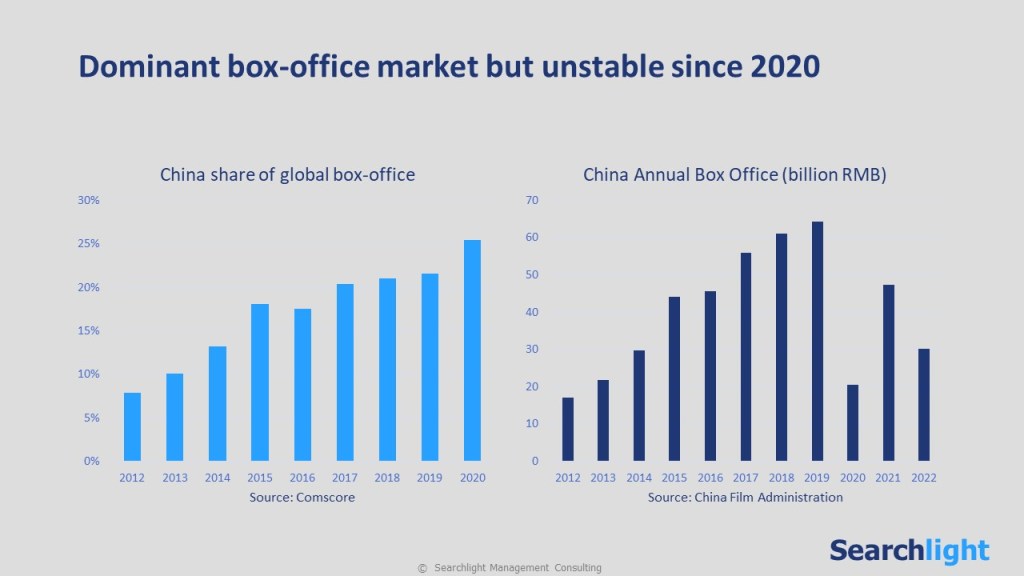
China was the biggest box-office market in 2021 (partly aided by lockdowns in the US) and with the lifting of COVID measures, is likely to come roaring back in 2023

It’s been a long time since I’ve been to a movie hall in China. The last time I went, every alternate seat was blocked off, no food or drinks were allowed inside and people had to keep their masks on all the time. Then, once the lockdowns of 2022 started, for several months there was no question of going to the cinema at all.

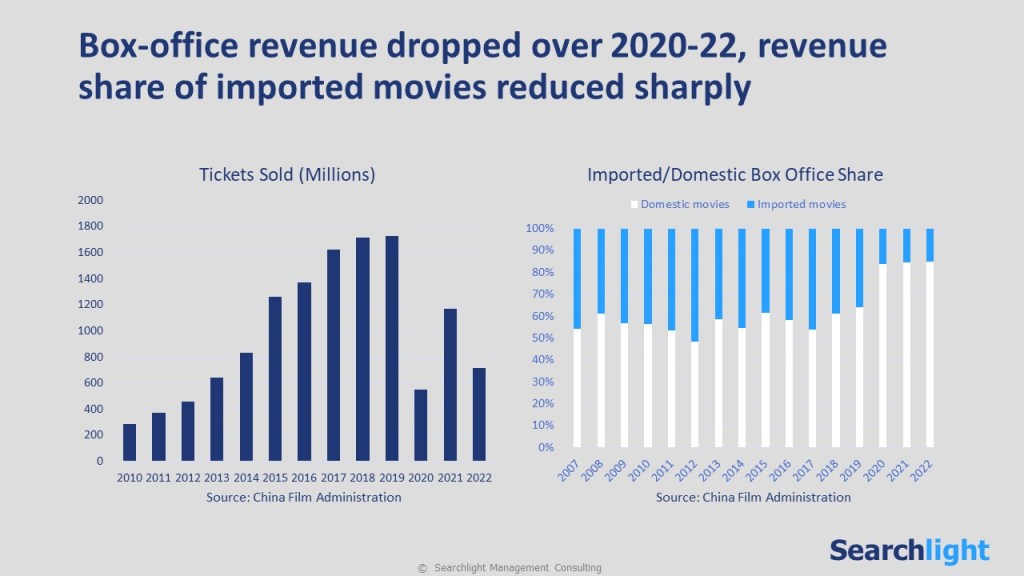
China has been one of the key cinema markets in the world, but over the last few years, box-office revenue has dropped significantly (as it did everywhere else).

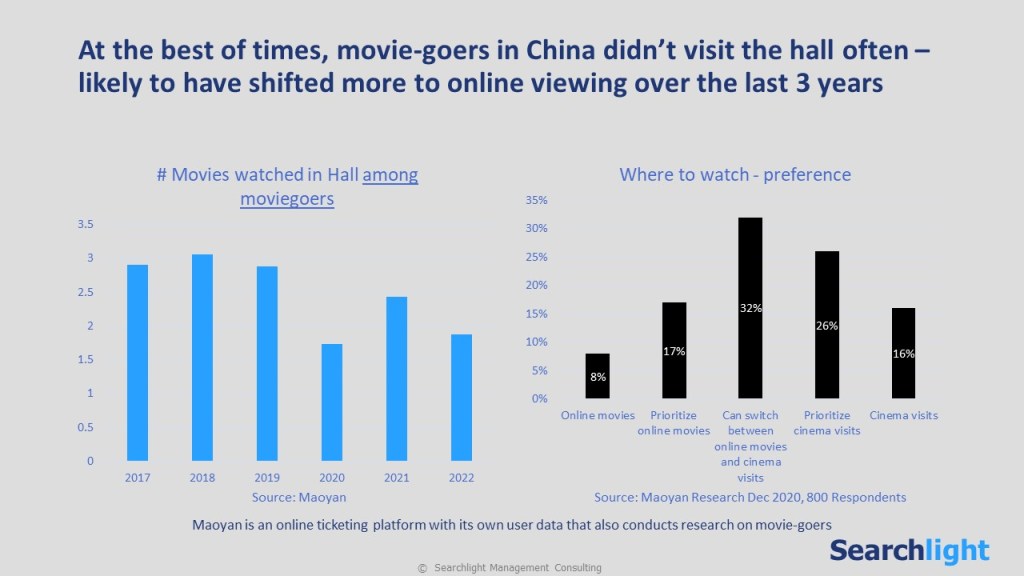
Two key trends that may continue to impact the future though, are the reducing share of imported movies and the increased viewing habit online instead of in movie halls.

As we noted in our 2023 China Outlook report (you can get your free copy here) Chinese consumers are expressing a desire to escape stress and also may be more open to international brands, overseas travel and the world in general in months and years to come.

That should represent an opportunity for international movie producers to get back into cinemas in China and benefit from the boost as the industry revives. However, that might mean also paying attention to the home-viewing model and working out deals with the major streaming platforms in the market.

At Searchlight, we’re optimistic about China 2023. As you re-evaluate your plans and strategies for China, reach out to us on enquiries@searchlight.com if you need advice on understanding the business opportunities and leveraging them with the right strategic choices.

China 2023 – The Return of Opportunity

China has finally emerged from zero-COVID. Once the population recovers from mass infections, we see a significant opportunity for brands and businesses to get back to growth in China in 2023 and beyond. Get our detailed report based on official economic statistics, consumer research and social media trends.

← Back

Thank you for your response. ✨

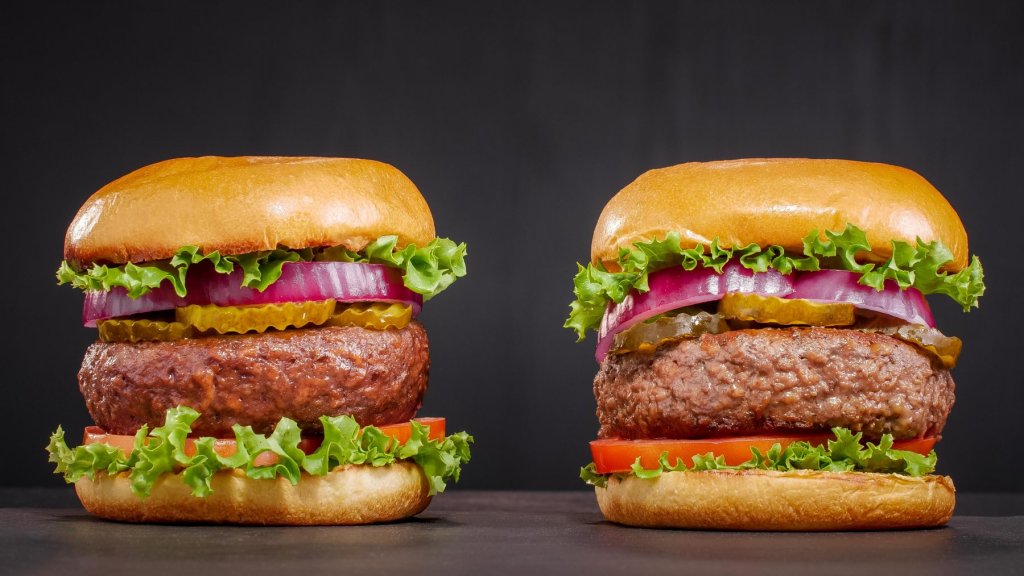
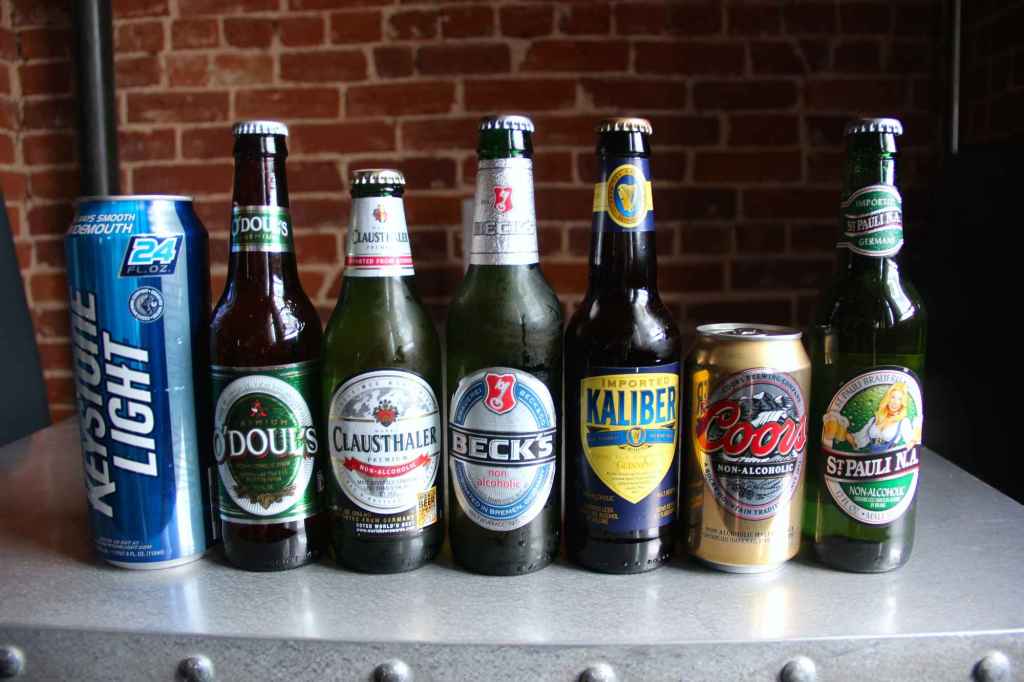
Fake meat and non-alcoholic beer – why one does well while the other struggles

Quick – which do you think is doing better in the market? Plant-based meat or non-alcoholic beer? It may not be the one you read about more often these days...

In recent times, companies like Beyond Meat have brought plant-based meat substitutes into the public eye considerably.

However, when examining some facts and figures about meat and meat substitutes, an OECD (data.oecd.org) study shows a volume of 323 million metric tons of consumption in 2020 for all types of meat, while meat substitutes of all types accounted for 470 million kilograms in 2020 – converted to metric tons that’s only 470,000 tons. That’s a share of 0.145% – absolutely miniscule.

By contrast, non-alcoholic beer seems to be doing much better. While there isn’t a single global volume share number available as easily, total global revenue is estimated at 25 billion USD out of a total beer market of 528 billion USD – a share of 4.7%. That’s pretty significant and shows that non-alcoholic beer has made a niche for itself that somehow, plant-based meat has not.

So, based on the numbers, non-alcoholic beer is doing about 30 times better than meat-substitutes – plant-based meat being only a small part of that latter category.

The question becomes, why is it this way? And the answer, as always, lies in what consumers really want and whether or not brands are able to truly satisfy those wants.

While there doesn’t seem to be one comprehensive survey asking the same questions, surveys about why consumers choose non-alcoholic beers show a few key reasons popping up consistently. Across South-East Asian countries, reasons around “cutting down alcohol consumption” or “cutting down calories from drinking” are big reasons – suggesting that people who regularly consume alcohol choose non-alcoholic beer to control their intake. Reasons cited in European countries are similar, though usually expressed as wanting to avoid the side-effects of drinking too much alcohol (hangovers, mostly). Consistently across markets, non-alcoholic beers rate as refreshing, good-tasting, satisfying, and often even healthier than traditional soft drinks.

Surveys around why people consume plant-based meat cite two key reasons consistently – a perception that meat-substitutes / plant or soya based meat is healthier, and a perception that it is better for the planet. A US survey shows a per capita consumption of 0.3 kg of meat-substitutes a year, out of a total per capita meat consumption in excess of 98 kg. That’s a share of less than 0.03% – which suggests that even the people who cite these reasons for eating meat-substitutes aren’t eating a lot of it. Also, comparisons of the nutritional value of several different brands of plant-based burgers show that they often fail the two fundamental premises on which consumers choose them – being healthier than meat and tasting similar to meat.

Perhaps the core problem is that meat-substitutes don’t really have a clear target segment. Non-alcoholic beers aim at people who normally drink beer, but for a variety of reasons don’t want to do so. Which leaves plenty of room for something that tastes and feels like a beer but isn’t alcoholic.

Last of all, while a lot of non-alcoholic beers taste like the real thing and cost a lot less, the better tasting meat-substitutes are usually much more expensive than the real thing.

Interestingly, China is the largest market in the world for meat-substitutes, at USD 2.24 billion in 2022 (estimated) out of an estimated global total of around USD 7 billion. Also, while per capita consumption of meat-substitutes is low at 0.1 kg, it is a larger percentage of the per capita meat consumption of around 40kg, which is a signal for potential growth as meat consumption in the market grows.

All of which would seem to point to China being a better place to focus on meat-substitutes than most other markets, but doesn’t take away the challenge of segmenting consumers based on their needs and picking a segment that you can actually win in.

For deeper data and insights on how you might go about doing this in China, get in touch with us at enquiries@searchlightchina.com

Famous in China (9)

The largest selling brand of BEV (battery electric vehicles, basically 100% electric) is the Chinese brand BYD (比亚迪) which has recently overtaken Tesla – a classic example of a brand that’s famous in China and actually leads its category, but isn’t known in the rest of the world.

Sales of electric vehicles continue to grow around the world, with more than 3 million units having been sold from January to May in 2022, compared to 1.7 million in the same period of 2021 (an increase of more than 80 percent). According to data from CleanTechnica, BYD produced 506,868 fully electric cars in the first half of this year, which is a market share of 15.6 percent. Meanwhile, Tesla produced only 406,869 of the cars, making up 12.6 percent of the global comparison.

BYD Auto had it’s beginnings in 2003, in Xi’an, after BYD Co. Ltd. acquired Qinchuan Machinery Works which had a license for automobile production. BYD made the world’s first production-model plug-in hybrid car, the BYD F3 compact sedan, which became China’s best-selling sedan in 2009. BYD then started expanding outside China, competing mainly on price in Africa, South America and the Middle East.

However, before venturing into automobile manufacturing, BYD Co. Ltd. was focused on rechargeable batteries – with an IPO in Hong Kong in 2002 based on it’s success in that business. The 2003 purchase was opportunistic, a chance to buy a going automobile producer from a conglomerate that wanted to get rid of it, while local government was keen to keep the factory going as a source of employment.

BYD Auto started off “reverse engineering” other cars to learn how to build them. There is a story around the founder bringing his brand-new Mercedes S-Class to his R&D center, handing over the keys to his team and instructing them to take it apart so they can study it. Over the years, BYD graduated from this to improving on what they saw and moving from internal combustion to plug-in hybrids to BEVs.

BYD Auto has some unique core strengths fueling it’s success. First, it started as a rechargeable battery company and the purchase of an auto manufacturing facility was partly to start creating a bigger market for batteries. Second, the founder is primarily an innovator and engineer who drives a culture of solving technical problems.

From being seen as a cheap, low-quality car brand, BYD has changed over the years and become one of the two leading Chinese car brands, acquired it’s own design aesthetic and from a position of strength, signed JVs with leading global automakers. The 2021 BrandZ survey of top Chinese brands shows BYD ranked 29th amongst a very broad field of ALL consumer facing brands (up from 45 the previous year) and ahead of all the other local car brands. (https://www.chinainternetwatch.com/30833/brandz-top-brands/)

China has been at the forefront of encouraging the development of hybrids and electric vehicles and BYD, SAIC and the other car manufacturers have all benefited from a faster pace of development of both consumer demand and supply-side technology in this market.

A look at the 2021 annual report reveals a revenue of 211 billion RMB at a net profit margin of 1.4%. However, almost half this revenue comes from the older BYD revenue streams of batteries and mobile handset components – with 51.09% coming from automobiles. Sales in the PRC account for 69.76% of the company’s revenue.

The original HK public company still exists but shows a small revenue of under 2 billion HK$ – clearly the China listed company is the main entity now.

With it’s strong engineering DNA, a robust brand that is now ranked well by consumers and a leading share of the global market, BYD is well-poised to build on their early success and continue to dominate the global auto market to the point where they’re famous not just in China, but around the world.

While our focus as a consultancy is making new brands famous in China, there are many (already) famous Chinese brands that aren’t well known overseas. We will be bringing them to light in this series over time.

Famous in China (8) – Or not quite…?

Sometimes you miss a chance to become a household name because despite being literally in every household…you don’t have a name… does that matter?

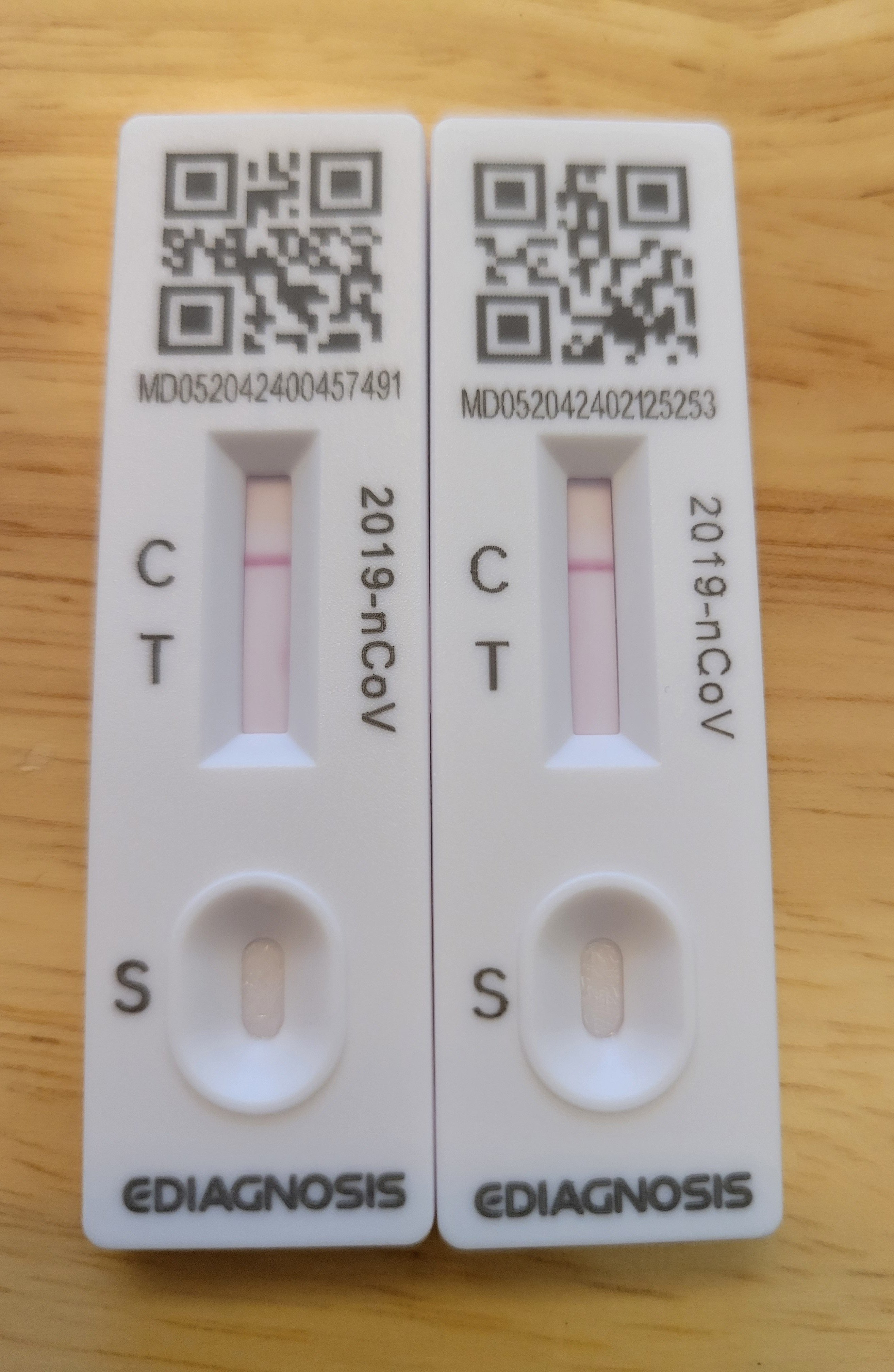
Pretty much every morning for almost 6 weeks, we started and ended our day posting our self-test result photographs within our building’s WeChat group to be collated and reported to the local authorities

Over the last few months, China went through a series of pretty strict lockdowns. Starting with Shenzhen early in the year, Shanghai from March through May and Beijing a little later, the focus on Zero-Covid has meant varying degrees of restriction on movement and importantly, a regular schedule of testing for COVID. That typically means going down for a nucleic acid test most days as well as doing two self-tests a day.

With 25 million residents in Shanghai doing 2 self-tests a day, every day for several weeks, that’s several hundred million test-kits being sold. These seem to come mostly from two companies (Zhejiang Orient Gene Biotech – http://www.orientgene.com and Wuhan Ming De Gene Biotech – mdeasydiagnostic.com).

So every day, consumers all over Shanghai and other cities (total population affected by lockdown was a staggering 140 million at its peak) are looking at one of these self-test kits twice. Close up… and they’re typically taking a photo and recording it in their neighborhood group, often also uploading it into the health-code app. In normal consumer behavior terms we’d look at that as really deep brand interactions, sharing content and so on.

Except… there’s no brand. The kits carry the name of the company, but that’s pretty meaningless since consumers aren’t familiar with it.

You could argue that it doesn’t matter – the kits are procured by the government and distributed for free at this point and having a brand wouldn’t make a difference to that.

Both companies have a global presence and ambition – Zhejiang Orient Gene apparently sells COVID self-tests in over 100 countries via government procurement and Wuhan MingDe lists various international dignitaries visiting their facilities and being given an exhibition of capabilities in this area. Clearly, being a Chinese company, their default business model is to engage with governments rather than think of engaging consumers.

What about the future though? When people buy self-test kits because they need to travel or show a negative test for their own purposes, but the population at large doesn’t need to be tested? That opportunity is going to be around for a long time – I suspect we’ll still be worrying about COVID for another 5 years or so. It is unlikely that the government will continue to be involved in procuring kits – especially outside China – for that long. Most likely there will be a set of standards for the kits, perhaps an approval process for a manufacturer to quality and then it’s up to them to distribute to consumers through the OTC channels.

On the one hand, these two companies have done remarkably well to be ready with a mass-produced self-test kit that is now reaping significant revenue rewards. However, that large-scale opportunity is unlikely to last longer than a few months and they will end up having one spectacular year in 2022 but not being able to replicate it. The bigger opportunity that they could have built on for the long-term is to build a name as a brand of self-test kits for consumers to buy whenever they need – given how COVID has evolved this is likely to be a continuing need – but they don’t have to restrict themselves to COVID or even just to self-test kits in the future. The B2C market for flu & COVID self-test kits over the next few years, especially when viewed at a global level, will be a consistent opportunity for these hitherto B2B companies to build a consistent stream of new revenue. That opportunity could have had a huge kickstart over the past two months by exploiting the twice-daily exposure to huge numbers of consumers.

The lockdowns in Shanghai and Beijing seem to be lifting and while there may be some isolated “dynamic” closures of smaller parts of these megapolises, it feels like the window of opportunity for these companies is fast closing and they’ve missed out on the chance to build a brand that can drive a new, steady revenue source for years to come.

At Searchlight Management Consulting, we can help clients navigate new business models and revenue streams that may seem unfamiliar and forbidding. Write to us at enquiries@searchlightchina.com .

Lockdown Creates Time to Find Opportunity

Tactics is knowing what to do when there is something to do. Strategy is knowing what to do when there is nothing to do.
– Chess Grandmaster Savielly Tartakower

As Shanghai enters its 8th week of city-wide lockdown, and other cities are just beginning their COVID measures, times have never been tougher for many businesses. With workers at home, factories and warehouses closed, and customers not buying, work has slowed and getting the simplest of things done can be a challenge. But with the right approach there could be a silver lining; it is possible to take advantage of the strange times we find ourselves in.

More time means time for strategy

To elaborate on Tartakower’s brilliant quote above, we tend to spend much of our working lives on the tactical; knowing what to do and getting it done before moving on to the next pressing task and leaving little time for the strategic. Over time, as the focus is on the immediate tactical tasks, the work begins to drift further and further from the original strategy.

While the lockdown has created many immediate concerns for many businesses, it may also be the opportune moment to spend the time thinking about longer-term goals, determining priorities and correcting your course.

Strike while your competitors are asleep

As Mark Ritson has shown, companies who maintain or increase their advertising spend during a recession consistently outperform their competitors once the recession is over. This is because competitors are likely to decrease their spending so the reduced clutter increases the impact (and SOV) of any advertising that continues (not in terms of sales, because the whole market is likely to be down, but in terms of consumer recall). This greater impact results in gains in market share over the short term, which are maintained in the long term and where they translate to profitability. And while China is not in a recession, there is a similar reduction in marketing budgets.

What to do while we’re still locked down

So while lockdowns, and recessions, are difficult times for many they can also be times of opportunity. To start to find those opportunities, ask yourself and your team these questions:

  • What are our long-term goals, and do they still apply given the current situation?
  • Were we on the right path to achieving those goals, or could we find a better approach given what we now know?
  • What are our competitors doing in response to the lockdown, and how can we capitalise on this?

Navigating the complexities of the China market is not easy at the best of times, but Searchlight is here to help you find opportunities where there seem to be none, and to help capitalise on them. Reach out to us at enquiries@searchlightchina.com.

Shanghai lockdown – lessons for consumer businesses

Volunteers sorting delivery packages at the entrance of a residential compound

We’re now on day 36 of lockdowns in Shanghai (longer in Pudong) and it’s been very educational watching what consumers do, what they buy, which businesses manage to create opportunities for themselves and so on. Here are some key lessons we learned.

1. The importance of diversified supply chain

Shanghai is, after all, just one city. Even if it represents 25 or 50% of your business, there is still a market in other cities for most businesses that they can continue to service, possibly try to grow to compensate for the loss of revenue in Shanghai.

There are many companies who are unable to to do this for one simple reason – all their supply chain is in Shanghai and it’s been locked down with everything else.

While they’re trying hard to find alternative sources, it’s obviously very difficult to accomplish at short notice and while working from home.

2.The importance of diversified markets

By the same token, businesses that weren’t completely dependent on Shanghai have managed to keep their revenue chugging along – even if it’s not as healthy as before. This assumes, of course, that they weren’t entirely dependent on Shanghai for supply. Of course, Shanghai is a big market and there will be a revenue hit for a couple of months but that is less damaging than if it was your only market, which is the case for a lot of the smaller retail businesses that haven’t yet looked beyond one city.

3. Voluntary group-buys, a new (old) channel for brands to reach consumers directly:

As a preface to this point, bear in mind that big-city dwellers in China are used to a level of delivery convenience unparalleled elsewhere in the world. It was feasible to order a single drink (bubble-tea and such) because delivery costs were so low and it was possible for a delivery courier to show up right at your doorstep.

Obviously during lockdowns, couriers aren’t allowed beyond the main gate of a compound, most restaurants are closed anyway, most couriers are in the lockdown as well and no volunteer in a compound is going to appreciate making deliveries of small individual items – so that entire ecosystem crashed completely.

However, what took over very swiftly is various forms of group buys orchestrated via informal groups on WeChat (mostly). Residents of a building or compound coming together to meet a minimum order requirement for all kinds of things – from essentials like vegetables and dry goods to coffee, indulgences like KFC, Shake Shack and wine. After the initial few weeks of short supply, almost everything is now available through these channels and companies that have found ways to quickly build delivery capability and social media groups of their consumers have rescued at least some revenue through these means.

What’s particularly interesting about this new development is the brand-new, direct channel to groups of consumers who have self-selected themselves as being interested in a brand or category. Premium coffee drinkers ordering Nespresso pods, for example – under normal circumstances it would have been really difficult for a brand to find them – during the lockdown it’s become really easy because people are voluntarily registering to set up group buying, finding participants, collecting the money and placing the orders. Why should this stop when the lockdown ends? It’s a golden opportunity for brands to bypass normal distribution channels and sell directly to these consumers.

Incidentally, purchases during the lockdown weren’t just food / consumables / classic FMCG. Two appliances that have done really well (anecdotally, we don’t yet have hard data for this) are refrigerators – especially the smaller ones used as extra cold storage – and air-fryers. Given the number of people who would normally never cook for themselves who are now forced to do so, there are probably other kitchen appliances as well that have had some new opportunities come up during lockdown. Of course, if they weren’t adequately stocked in Shanghai before the lockdown started, that opportunity has passed them by.

Of course, lockdowns are (hopefully) not frequent, recurring events – for the most part it makes sense for businesses to optimize for business as usual, but these circumstances at least raise the question of having a plan B in place. Also, problems or crises often bring opportunities of their own, some of which can become long-term and very valuable for businesses that think differently and move quickly.

If your business in China is facing challenges that you’d like help to navigate, reach out to us at enquiries@searchlightchina.com